
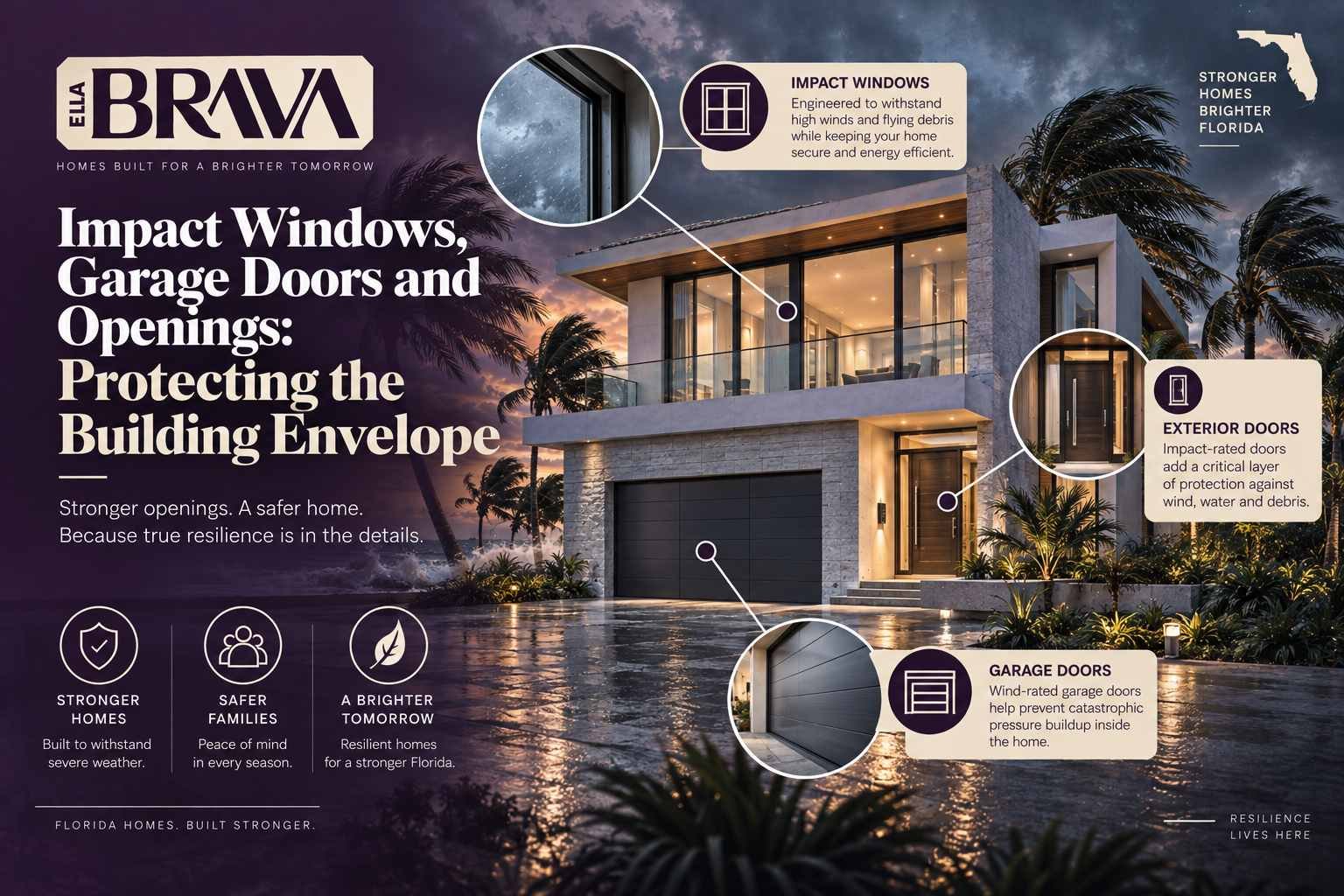
Homeowners planning a resilient Florida build tend to focus their attention on the wall system, and understandably so. But walk through almost any post-storm damage assessment and a pattern shows up quickly: openings, not walls, are where wind and water most often find their way in. Windows, exterior doors, sliding glass doors, and garage doors interrupt an otherwise continuous structure, and each one has to be engineered on its own terms to hold up under the same forces the walls around it are designed to resist.
A strong shell with unprotected openings is still a vulnerable home. Understanding why openings matter, and what "protected" actually means, is essential before finalizing any Florida home design.
Every window, door, and garage door is a break in an otherwise solid wall. That break has to be framed, sealed, and structurally connected back into the surrounding wall system, and the moment any one of those details underperforms, the opening becomes the path of least resistance for wind pressure and wind-driven rain.
There's also a secondary risk that's easy to overlook: once wind enters a home through a failed opening, internal pressure builds rapidly and pushes outward against the roof and walls from the inside. A single compromised garage door or window can meaningfully increase the load the rest of the structure has to withstand. This is part of why impact-rated openings aren't a cosmetic upgrade, they're a structural consideration tied directly to how the whole envelope performs.
Impact-rated windows and doors are engineered and tested to resist windborne debris impact along with the wind pressures specific to a project's design requirements, rather than simply being built from thicker glass or heavier materials. Actual performance is tied to the exact tested assembly, including the frame, glazing, anchoring method, and installation detailing, not just the product name on the label.
We never quote a wind or impact rating that isn't backed by the exact product documentation for that opening on that project. It's one of the easiest claims to get wrong, and one of the most important to get right.
Beyond meeting the project's design pressure and impact requirements, window placement, size, and orientation should be coordinated with the architecture early, since larger openings and unconventional shapes often require more specific engineering and product selection.
Large sliding and multi-panel doors are increasingly popular in Florida indoor-outdoor design, but they're also some of the largest openings in a home's envelope. Track systems, anchoring, and glazing all need to be rated for the same loads as the rest of the opening strategy, not treated as a separate, purely aesthetic decision.
Garage doors are frequently the largest single opening in a home and, because of their size and the way they're mounted, are one of the more common failure points in a storm. A garage door rated for the home's specific wind pressures, with properly engineered track and anchoring hardware, is a meaningful part of the whole-home resilience strategy, not an afterthought to the garage itself.
| Opening Type | Primary Risk | What Protection Requires |
|---|---|---|
| Windows | Debris impact, water intrusion at the frame | Rated glazing and frame matched to project design pressure |
| Sliding / exterior doors | Large surface area, track and anchor failure | Rated track and anchoring system for the opening's full span |
| Garage doors | Largest opening, higher internal pressure risk if compromised | Rated door panel with reinforced track and header connection |
An impact-rated window installed into a wall that wasn't engineered to receive it, or a garage door rated for the wrong design pressure, doesn't deliver the protection its rating implies. Openings have to be selected and installed as part of the same coordinated system as the structure, roof, and foundation, sized and specified for the project's actual site conditions rather than chosen generically.
This is why EllaBrava coordinates opening selection alongside structural engineering from early in the design process, rather than treating windows, doors, and garage doors as finishing decisions made once the shell is already built.
A builder who can answer these clearly, opening by opening, is treating your building envelope as a system. A generic answer about "impact glass" is a sign the conversation needs to go further.
We coordinate windows, doors, and garage doors as part of the structural design from day one, not as a finishing touch. Let's review what your site and design actually require.
Talk to Ella BravaNo. Impact windows are engineered as part of the window assembly itself, while shutters are a separate protective layer installed over standard or impact-rated openings. Some homeowners use both; the right approach depends on the project's design, budget, and local requirements.
Not necessarily. Required design pressure and impact resistance can vary by opening size, story height, and location on the building, which is why each opening should be specified based on the project's engineering rather than a single blanket product choice.
In many cases, yes, through replacement with rated products sized and anchored for the opening. Any retrofit should be evaluated against the home's actual structure and current Florida Building Code requirements by a qualified professional.