
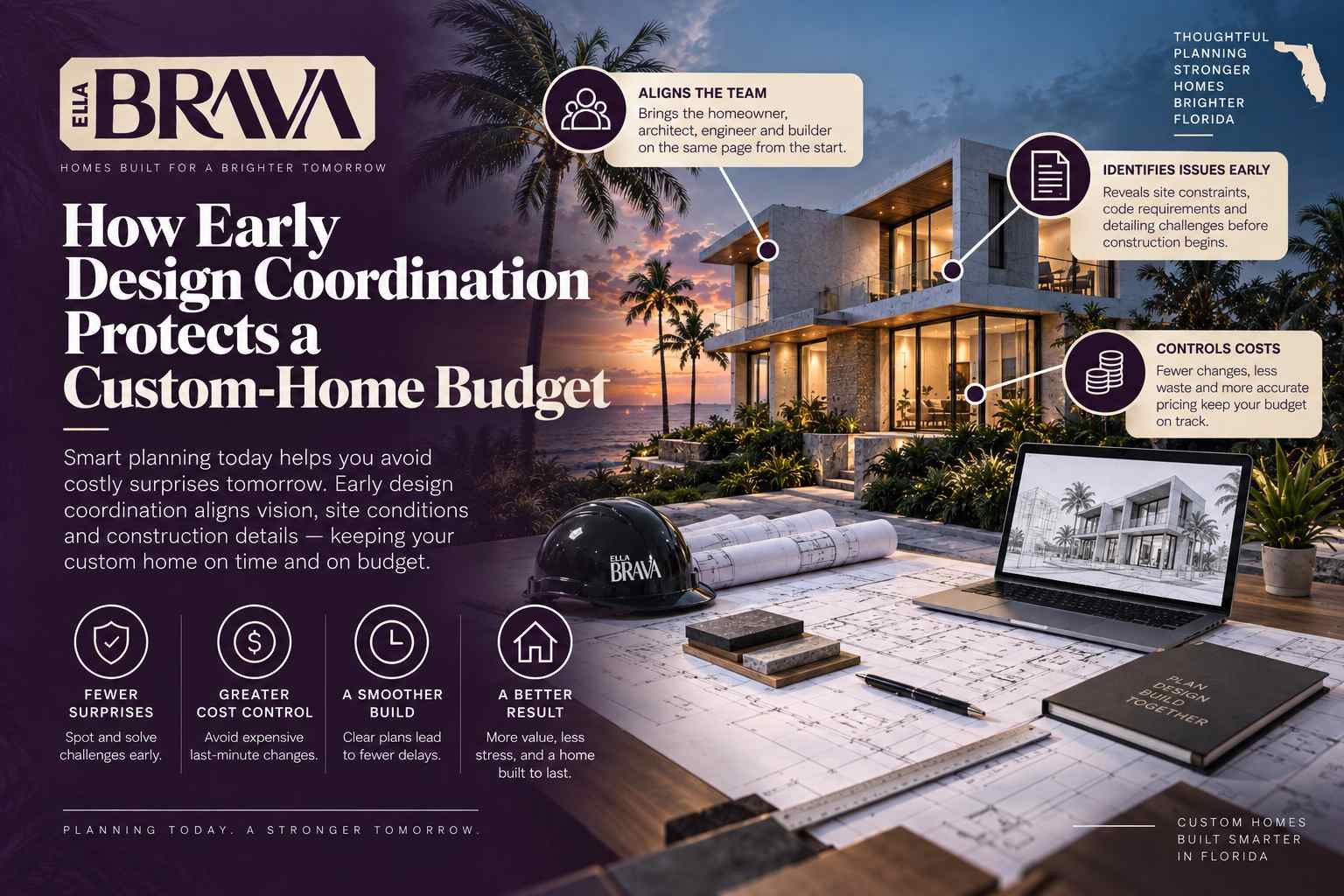
A custom home budget can change long before the first shovel reaches the ground. Decisions about the site, floor plan, structure, windows, insulation, mechanical systems, finishes, and construction methods all influence one another. When those decisions are made independently or too late, the result can be redesign, substitutions, change orders, delays, or compromises that were never part of the original vision.
That is why early design coordination matters. It brings the major decisions together while there is still time to evaluate their cost and consequences.
The most effective way to protect a custom-home budget is not to wait for construction costs to appear. It is to coordinate the important decisions before they become expensive to change.
For a Florida custom home, this approach can be particularly valuable. Site conditions, flood exposure, structural requirements, energy performance, hurricane-resilient detailing, material availability, and local permitting requirements can all affect the final cost of the project.
Budget control begins with coordinated decisions, not with last-minute cost cutting.
Early design coordination means bringing the major project disciplines and decisions together before construction begins.
Instead of developing architecture first and solving structure, mechanical systems, site conditions, and construction details afterward, the team considers how those elements interact from the beginning.
Depending on the project, coordination can involve the homeowner, architect or designer, builder, structural engineer, civil or site professionals, mechanical specialists, and other consultants.
The goal is not to design every detail immediately. It is to identify the decisions that have significant cost, performance, or constructability consequences while those decisions are still flexible.
Most major budget problems are not caused by one isolated decision. They often develop when several individually reasonable decisions conflict with one another.
A larger window package may affect structural requirements. A complicated roof may increase framing and waterproofing complexity. Moving a room may change plumbing runs. A late material substitution may require a different installation method.
Each change can create additional work because construction systems are connected.
Early coordination gives the team an opportunity to see those relationships before they become field changes.
Changing a drawing is generally different from changing something that has already been engineered, ordered, fabricated, delivered, or installed.
A wall can be moved relatively easily during design. Once framing, concrete, plumbing, electrical work, finishes, or cabinetry have been installed, the same change can involve multiple trades.
This is one reason detailed planning has financial value even when it adds time to the early design process.
A custom-home budget can move for many reasons, and not all of them are visible in the initial floor plan.
None of these categories is inherently problematic. The problem is allowing their implications to remain unknown until late in the project.
A custom home starts with a piece of land, not a floor plan.
The site's dimensions, orientation, topography, access, drainage, flood conditions, utilities, setbacks, easements, vegetation, and surrounding properties can all influence the cost of building.
A house designed without understanding those conditions may require significant revisions later.
Early site coordination helps establish where the home should sit and what site-development work may be necessary before the architectural design is pushed too far.
Florida properties can have very different site conditions even within the same general region. Coastal exposure, flood considerations, drainage, elevation, soil conditions, mature vegetation, and utility arrangements can all influence design and construction decisions.
Understanding those conditions early allows the budget to reflect the site rather than treating site work as an unknown allowance.
The architectural concept and structural system are closely connected.
Large glass walls, long open spans, cantilevers, tall spaces, unusual roof forms, deep overhangs, and complex geometry may be exactly what gives a custom home its character. They also have structural and construction implications.
Bringing structural thinking into the design process early does not mean limiting creativity. It means understanding the structural consequences while there is still time to make informed choices.
When a project uses a concrete-based structural system, the design team needs to coordinate wall locations, openings, connections, roof conditions, reinforcement, insulation, and other components before construction.
The more integrated the structural system is, the more valuable early coordination becomes.
This is particularly relevant when evaluating systems such as Structural Concrete Insulated Panels, or SCIP, where structure and insulation are integrated within the wall assembly.
Windows, exterior doors, insulation, roofing, waterproofing, and wall assemblies are often treated as finish decisions. In a resilient custom home, they are performance and budget decisions as well.
Window size and placement can influence structure, energy performance, interior comfort, and exterior appearance. Insulation strategies can affect wall thickness and detailing. Waterproofing and flashing decisions can influence both durability and installation requirements.
Coordinating these decisions early reduces the chance that one system will need to be redesigned because another system was developed independently.
| Design Area | Potential Budget Impact | Why Early Coordination Helps |
|---|---|---|
| Site | Grading, drainage, utilities, access and site preparation. | Identifies site costs before the house design is locked in. |
| Structure | Spans, openings, geometry, materials and engineering complexity. | Allows architectural choices to be evaluated against structural requirements. |
| Windows & doors | Product selection, openings, structural requirements and installation. | Coordinates openings with structure and envelope performance. |
| Mechanical systems | Equipment, ductwork, electrical requirements and service space. | Prevents late conflicts with ceilings, closets, roofs and architectural spaces. |
| Interior finishes | Cabinets, stone, flooring, fixtures, lighting and appliances. | Keeps major selections aligned with allowances and available space. |
| Construction method | Labor, sequencing, material procurement and installation requirements. | Allows the design to respond to the actual construction system. |
Allowances can be useful during early budgeting, but an allowance is still an estimate for something that has not been fully selected or priced.
If too many important decisions remain unresolved, the apparent project budget can provide a false sense of certainty.
Early coordination helps identify which items need firm decisions, which can remain allowances, and which require additional investigation.
The objective is not to eliminate every unknown. That is rarely realistic in a custom project. The objective is to reduce avoidable uncertainty before construction begins.
A beautiful material can create problems if its dimensions, installation requirements, lead time, or compatibility with other systems are discovered too late.
This can happen with specialty windows, large-format tile, custom cabinetry, architectural lighting, stone, plumbing fixtures, doors, and other long-lead or highly coordinated products.
Early selection allows the design team to coordinate dimensions, openings, rough-ins, structural requirements, and installation conditions before construction reaches that stage.
It also gives the builder a better opportunity to identify procurement issues before they become schedule problems.
HVAC systems require physical space. Ductwork, equipment, electrical infrastructure, condensate drainage, ventilation, controls, and access for maintenance all need to work within the architectural design.
If those requirements are considered late, the solution may involve lowered ceilings, enlarged mechanical spaces, relocated closets, revised framing, or other compromises.
Early coordination allows mechanical requirements to be integrated into the home rather than treated as something that must fit wherever space remains.
Change orders are not automatically a sign of poor construction. Custom homes evolve, and legitimate changes sometimes become necessary.
The concern is avoidable change.
A late change can involve more than the price of the new material. It may also affect labor, demolition, engineering, scheduling, procurement, and work performed by other trades.
For example, changing a window after structural work has been finalized can have consequences beyond the window itself. Moving a plumbing fixture after rough-in can involve multiple trades. Changing a ceiling design after mechanical coordination can require ductwork revisions.
Early coordination does not prevent every change. It helps move more decisions to the point in the process where changes are easier to absorb.
One of the most useful habits in custom-home planning is to treat budgeting as an ongoing process rather than a single event.
As the design becomes more detailed, the cost picture should become more detailed as well.
This process gives the homeowner more opportunities to make intentional tradeoffs instead of reacting to unexpected costs after construction has started.
Budget control is sometimes misunderstood as a process of removing everything interesting from a design.
That is not the goal.
A well-coordinated project can actually make it easier to protect the features that matter most because the team understands where the money is going.
If expansive glazing, a particular concrete wall system, a large kitchen, a screened outdoor room, or a distinctive roof form is central to the homeowner's vision, those priorities can be identified early and incorporated into the planning process.
The question becomes: Where should the budget work hardest?
Florida adds another layer of coordination because the home must respond to a climate and regulatory environment that can influence structural, envelope, site, and mechanical decisions.
Depending on the location and property, the project may need to account for flood exposure, hurricane-related wind requirements, impact-resistant openings, drainage, high humidity, intense solar exposure, and other climate-specific conditions.
These are not necessarily separate design problems. They can interact with one another.
For example, window selection can affect both architectural appearance and hurricane-resilience requirements. Roof design can affect drainage, structure, and exterior appearance. Wall design can affect insulation, structural performance, moisture management, and interior comfort.
Coordinating those relationships early gives the project a better chance of achieving its performance goals without discovering conflicts after major decisions have already been made.
Early design coordination protects a custom-home budget by identifying costly conflicts, site constraints, structural requirements, material decisions, and construction implications before they become expensive changes in the field.
It does not guarantee a fixed construction price, and it cannot eliminate every unexpected condition. Instead, it improves the quality of the information used to make decisions.
The earlier the team understands the relationship between the site, architecture, structure, envelope, mechanical systems, materials, and construction method, the more opportunities the homeowner has to make informed choices.
A custom home is a collection of interconnected decisions. The site affects the house. The house affects the structure. The structure affects openings and materials. Mechanical systems need space within the architecture. Material selections influence procurement and installation.
When those decisions are coordinated early, the project team has a better opportunity to identify conflicts while they are still manageable.
That is what budget protection really means in custom-home construction: not promising that nothing will ever change, but creating a process where important changes are understood before they become expensive.
Good design is not only about how a custom home looks. It is also about making sure the decisions behind that home work together financially, technically, and practically.
Early coordination can help align your site, architecture, structure, building envelope, materials, and construction strategy before costly decisions become difficult to change.
Talk to EllaBravaEarly design coordination is the process of bringing major architectural, structural, site, mechanical, material, and construction decisions together early in the project. The purpose is to identify conflicts and cost implications while changes are still relatively easy to make.
It can reduce avoidable costs associated with late design changes, coordination conflicts, rework, procurement problems, and unexpected site requirements. It does not guarantee that the final project will cost less than every alternative or eliminate legitimate changes.
Involving construction expertise early can help the design team understand constructability, material availability, sequencing, procurement, and potential cost implications while the design is still flexible.
Early structural coordination can be valuable when the home includes large openings, long spans, unusual geometry, concrete construction, complex roof forms, or other features with significant structural implications.
There is no single schedule that fits every project, but the budget should be revisited as major scope, site, structural, mechanical, and material decisions become more defined. Waiting until construction begins to review the full cost picture leaves fewer opportunities for informed changes.
Allowances help establish provisional amounts for items that have not yet been fully selected or priced, but they do not provide the same certainty as finalized selections and current pricing. The more important the item, the more useful early selection and pricing can be.
Site conditions can affect where the house can be placed, how it should be oriented, what foundation approach may be appropriate, how drainage is handled, and what site-development work may be required. Understanding those conditions early can prevent major design changes later.
Not necessarily. Early coordination can help identify which design features matter most to the homeowner and direct resources toward those priorities. The objective is to make intentional tradeoffs rather than discovering unexpected costs after construction has already started.