
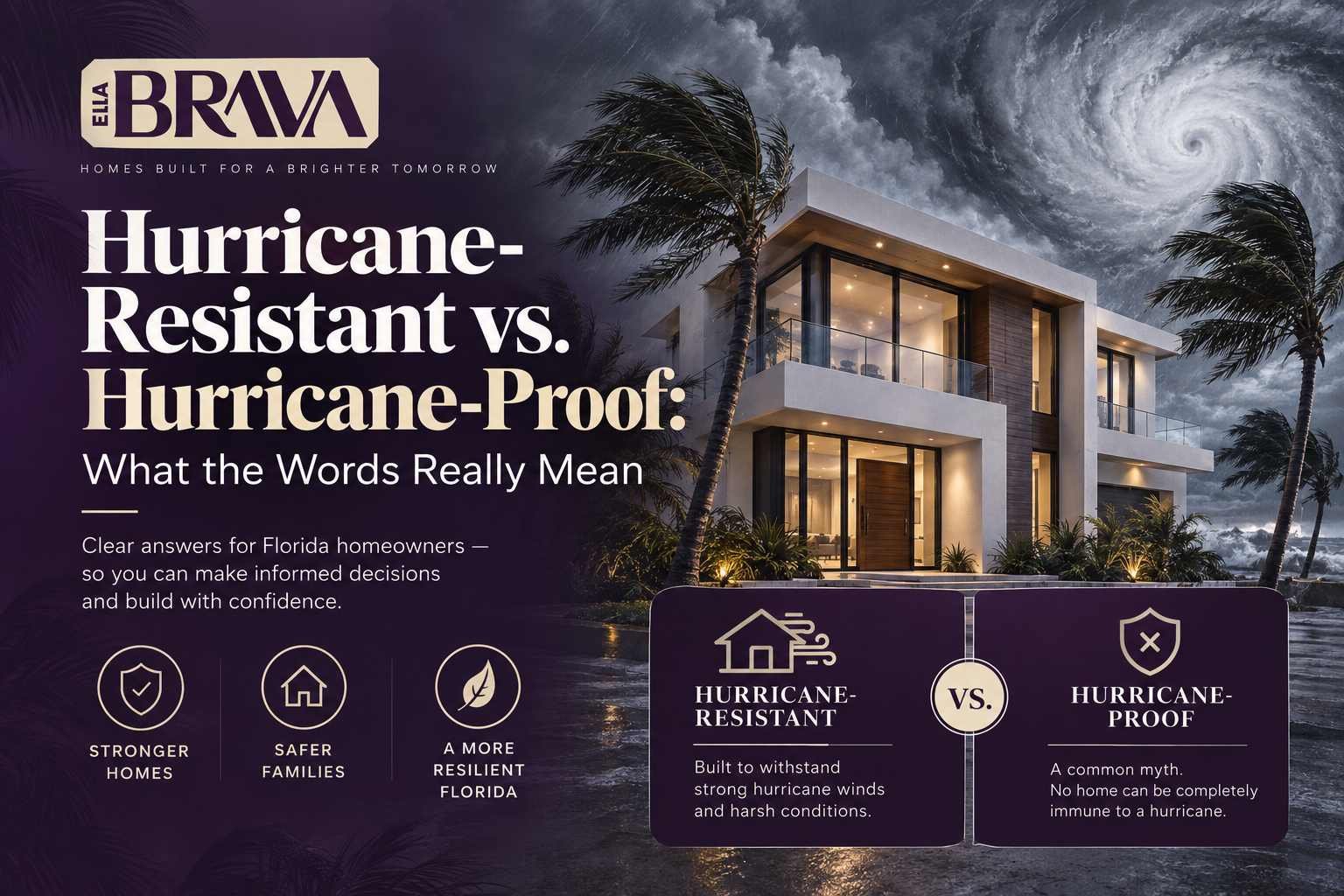
Every hurricane season, the same two phrases show up in builder ads, insurance conversations, and neighborhood chatter: hurricane resistant and hurricane proof. They get used almost interchangeably, and honestly, most people assume they mean roughly the same thing. They do not, and the difference is not just semantics. It affects what you should actually expect from your home when a real storm hits.
We think homeowners deserve a straight answer here, not a marketing spin, so let’s go through exactly what each term means, why one of them is quietly misleading, and what questions you should be asking instead.
Here is the uncomfortable truth: no home is hurricane proof. Not concrete, not steel, not any material or method available today. Wind loads, storm surge, flying debris, and prolonged saturation are forces that can overwhelm any structure given the right combination of intensity and bad luck. Engineers do not use the word proof because it implies a guarantee that physics simply cannot back up.
When you see “hurricane proof” in an advertisement, it is almost always a marketing phrase rather than an engineering claim. That does not automatically mean the product behind it is bad. It just means the word itself is doing more emotional work than technical work, and you should look past it to the actual specifications.
Hurricane resistant is the more honest and more useful term, because it describes a home built to withstand a defined level of wind load and impact risk, based on real engineering standards, rather than promising invincibility.
In Florida, this generally ties back to a few concrete references:
A hurricane resistant home is one engineered and built to meet or exceed these standards for its specific location. That is a meaningful, testable claim. “Hurricane proof” is not.
| Hurricane Proof | Hurricane Resistant |
|---|---|
| Implies total invulnerability to storm forces | Describes performance against defined, tested wind and impact standards |
| Not a recognized engineering classification | Directly tied to Florida Building Code and ASCE 7 requirements |
| Common in advertising and sales language | Common in permit documents, engineering reports, and product NOAs |
| Cannot be independently verified | Can be verified through permits, product certifications, and third party wind ratings |
This is not just a vocabulary lesson. The words a builder uses can tell you something about how they are approaching your project.
A builder who talks in terms of hurricane resistant construction should be able to point you to specific wind ratings, product NOAs, and how your home’s design meets your county’s required wind speed. A builder who leans on hurricane proof language without backing it up with documentation is asking you to trust a feeling rather than a spec sheet.
Insurance carriers do not underwrite based on marketing adjectives. They look at documented wind mitigation features, roof type and age, opening protection, and construction method. Knowing the real engineering terms helps you ask your builder for the documentation your insurer will actually want to see later.
A well built, properly engineered home can perform very well in a hurricane and dramatically reduce risk to your family and your investment. That is genuinely worth building toward. But going in with the expectation that any home is immune to a catastrophic storm sets you up for a false sense of security rather than informed preparedness.
We would rather tell a homeowner exactly what their home is engineered to withstand than sell them a word that sounds reassuring but cannot be backed up on paper.
Rather than chasing a marketing label, it helps to understand the handful of factors that genuinely move the needle on hurricane performance.
We go deeper into the first point in our companion article on why a continuous load path matters in hurricane country, and we cover openings specifically in our piece on impact windows, garage doors, and the building envelope.
A builder with real experience in hurricane resilient construction should answer these without hesitation. If the answers stay vague or lean back on reassurance rather than specifics, that is worth noticing.
We will walk you through exactly what your design is engineered to withstand, with the documentation to back it up, before you ever break ground.
Talk to Ella BravaNo. No construction method or material can guarantee complete invulnerability to hurricane force winds, storm surge, and debris impact. Hurricane resistant is the accurate term, describing a home engineered and tested against defined wind and impact standards for its specific location.
Ask for the engineered wind speed rating for your specific lot, Notice of Acceptance documentation for windows, doors, and garage doors, and details on how the roof, walls, and foundation are connected as a continuous structural system.
It can. Insurance carriers often consider documented wind mitigation features, including opening protection, roof type, and construction method, when calculating premiums, so keeping your engineering and product documentation on hand is worth doing regardless of when you built.